
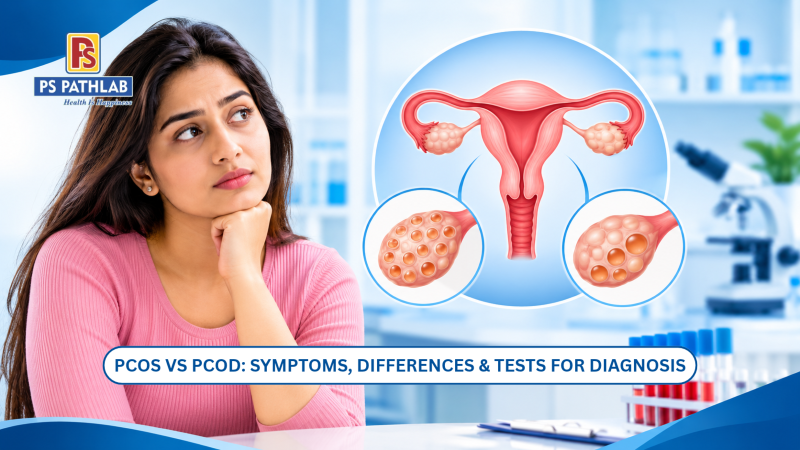
PCOS vs. PCOD: Symptoms, Differences, and Recommended Tests
Understand the difference between PCOS and PCOD, recognize common symptoms, and learn which diagnostic tests may help evaluate your hormonal health.
Hormonal health plays an important role in women's overall well-being. However, irregular periods, unexplained weight gain, acne, excessive facial hair, and hair thinning can sometimes indicate an underlying hormonal imbalance.
Two commonly discussed conditions associated with these symptoms are PCOS (Polycystic Ovary Syndrome) and PCOD (Polycystic Ovarian Disease).
Although these terms are often used interchangeably, they are not exactly the same. Understanding their differences, recognizing early symptoms, and getting appropriate medical evaluation can help women take better care of their reproductive and metabolic health.
In this guide, PS Path Lab explains PCOS vs PCOD, their symptoms, differences, and commonly recommended diagnostic tests.
What Is PCOS (Polycystic Ovary Syndrome)?
PCOS, or Polycystic Ovary Syndrome, is a hormonal and metabolic condition that can affect women during their reproductive years.
It is commonly associated with elevated androgen levels (sometimes called male hormones), irregular ovulation, and metabolic changes such as insulin resistance.
Women with PCOS may experience irregular menstrual cycles, acne, excessive facial or body hair, weight changes, and difficulty getting pregnant.
PCOS does not affect every woman in the same way. Some women experience several symptoms, while others may have only a few.
What Is PCOD (Polycystic Ovarian Disease)?
PCOD is a commonly used term referring to ovarian changes associated with hormonal disturbances and irregular ovulation.
Women described as having PCOD may experience irregular periods, weight gain, acne, and difficulty with ovulation.
It is important to understand that PCOD is not a separate, universally standardized diagnostic category in the same way as PCOS. In clinical practice, the term PCOS is more widely recognized and used in medical guidelines.
PCOS vs PCOD: What Is the Difference?
PCOS and PCOD are frequently confused because their symptoms can overlap. However, their terminology and clinical usage differ.
FeaturePCOSPCOD
Full form | Polycystic Ovary Syndrome | Polycystic Ovarian Disease
Medical terminology | Recognized clinical syndrome | Commonly used term
Hormonal changes | Often involves elevated androgen levels | May involve hormonal disturbances
Ovulation | Frequently irregular | May be irregular
Menstrual cycle | Irregular or absent periods | Irregular periods may occur
Metabolic concerns | Insulin resistance and metabolic risks may occur | Depends on the underlying condition
Diagnosis | Clinical assessment and diagnostic criteria | Requires appropriate clinical evaluation
Important: Neither condition should be diagnosed through symptoms or an ultrasound report alone. A healthcare professional evaluates the complete clinical picture.
Common Symptoms of PCOS and PCOD
The symptoms can vary from woman to woman. Some commonly reported signs include:
1. Irregular Periods
Menstrual cycles may become irregular, infrequent, or absent due to problems with regular ovulation.
2. Unexplained Weight Gain
Some women experience weight gain, particularly around the abdominal area. Insulin resistance may contribute to metabolic changes.
3. Acne and Oily Skin
Elevated androgen levels can increase oil production, potentially causing persistent acne.
4. Excessive Facial or Body Hair
Increased androgen activity may cause unwanted hair growth on the chin, upper lip, chest, or abdomen.
5. Hair Thinning
Some women experience thinning hair or increased hair loss, particularly around the scalp.
6. Difficulty Getting Pregnant
Irregular ovulation can make conception more difficult for some women.
7. Dark Patches on the Skin
Dark, thickened skin around the neck, underarms, or skin folds may be associated with insulin resistance.
Not every woman with these symptoms has PCOS. Other medical conditions can cause similar problems, so proper evaluation is important.
Recommended Tests for PCOS Diagnosis
There is no single blood test that confirms PCOS. Doctors may recommend a combination of hormonal, metabolic, and other investigations based on symptoms and medical history.
The following tests may be considered:
1. TSH (Thyroid-Stimulating Hormone)
A thyroid function test that helps evaluate thyroid disorders, which can also cause irregular menstrual cycles.
2. LH (Luteinizing Hormone)
This hormone plays an important role in ovulation. Its level may be assessed during hormonal evaluation.
3. FSH (Follicle-Stimulating Hormone)
FSH helps regulate ovarian function and follicular development.
4. Prolactin Test
Elevated prolactin levels can contribute to menstrual irregularities and should be evaluated when clinically indicated.
5. Total Testosterone
This test helps assess androgen levels. Elevated testosterone may be associated with symptoms such as acne and excessive facial hair.
6. DHEA-S
This hormone test may help evaluate androgen production, particularly when symptoms suggest excess androgen activity.
7. HbA1c (Glycated Hemoglobin)
HbA1c measures average blood glucose levels over approximately two to three months. It can help assess diabetes risk, which is particularly relevant in women with PCOS.
8. Fasting Blood Glucose
This test measures blood sugar after fasting and may be used as part of metabolic screening.
9. Lipid Profile
A lipid profile evaluates cholesterol and triglyceride levels to assess cardiovascular and metabolic risk.
10. Pelvic Ultrasound
A healthcare professional may recommend pelvic ultrasound to examine ovarian appearance and assess other reproductive health concerns.
Remember: Not every woman requires all these tests. The treating doctor decides which investigations are appropriate. An LH/FSH ratio or ovarian ultrasound alone cannot establish a PCOS diagnosis.
When Should You Get Tested for PCOS?
Consider consulting a gynecologist or healthcare professional if you experience:
- Frequently irregular or missed periods.
- Persistent acne or excessive facial hair.
- Unexplained weight changes.
- Hair thinning or unusual hair loss.
- Difficulty conceiving.
- Dark patches around the neck or underarms.
Early evaluation can help identify hormonal or metabolic concerns and guide appropriate management.
Can PCOS Affect Fertility?
Yes, PCOS can affect fertility because irregular ovulation may reduce the chances of conception.
However, having PCOS does not mean that pregnancy is impossible. Many women with PCOS conceive naturally or with appropriate medical support.
A healthcare professional can recommend suitable investigations and treatment depending on individual circumstances.
Lifestyle Tips to Support Hormonal Health
Healthy lifestyle habits can support overall metabolic and reproductive health.
- Maintain a balanced and nutritious diet.
- Include regular physical activity.
- Maintain a healthy weight.
- Get sufficient sleep.
- Manage stress through healthy routines.
- Attend recommended health checkups.
- Follow medical advice for hormonal or metabolic concerns.
Lifestyle changes may improve some PCOS-related symptoms, but they do not replace medical evaluation or prescribed treatment.
Frequently Asked Questions (FAQs)
1. Is PCOS more serious than PCOD?
PCOS is a recognized hormonal and metabolic syndrome that may involve long-term health risks. PCOD is a commonly used term and should be clinically evaluated rather than automatically considered a milder condition.
2. Which blood tests are required for PCOS?
Depending on symptoms, a doctor may recommend TSH, LH, FSH, prolactin, testosterone, DHEA-S, HbA1c, fasting blood glucose, and a lipid profile.
3. Can PCOS be detected through a blood test?
Blood tests can help identify hormonal and metabolic changes associated with PCOS. However, no single blood test confirms the condition.
4. Is ultrasound necessary for PCOS diagnosis?
Not always. In adults, PCOS can sometimes be diagnosed using other clinical criteria without an ultrasound when the required features are already established and alternative causes have been excluded.
5. Can PCOS cause weight gain?
PCOS may be associated with weight gain and insulin resistance, although not every woman with PCOS experiences weight gain.
6. Can PCOS be cured permanently?
There is currently no permanent cure for PCOS, but symptoms and associated metabolic risks can often be managed through lifestyle changes and appropriate medical treatment.
7. Is fasting required for PCOS blood tests?
It depends on the tests prescribed. Some glucose and metabolic investigations may require fasting, while many hormonal tests do not. Follow the instructions provided by your healthcare professional or laboratory.
8. When should women get a PCOS test?
Women experiencing irregular periods, persistent acne, excessive facial hair, unexplained weight changes, or fertility concerns should consult a healthcare professional for evaluation.
Get Your Diagnostic Tests at PS Path Lab
Your hormonal health deserves attention and timely evaluation.
At PS Path Lab, we offer a range of diagnostic investigations to support women's health, including hormonal testing, thyroid profiles, blood glucose testing, HbA1c, and lipid profile investigations.
If you are looking for diagnostic testing in Pitampura, Rohini, or nearby areas of Delhi NCR, our team can help you inquire about available tests and home sample collection services.
PS Path Lab – Health Is Happiness
📍 Address: 198 Deepali Enclave, Pitampura, Basement, Delhi – 110034
📞 Contact: +91 96674 92046
🌐 Website: https://www.pspathlab.com/