
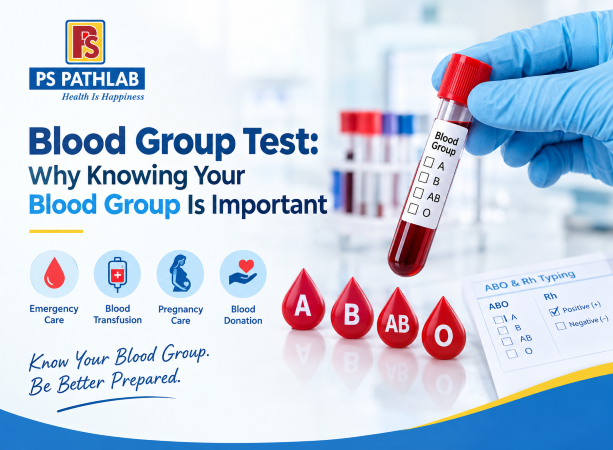
Have you ever wondered why knowing your blood group is important? Your blood group is a vital piece of health information that can play a crucial role during medical emergencies, blood transfusions, surgeries, pregnancy, and blood donation.
A simple blood group test can identify your blood type and help you understand an essential aspect of your health profile.
At PS Path Lab, we believe that preventive healthcare begins with awareness. In this blog, let's explore the importance of blood group testing, different blood group types, and why everyone should know their blood group.
What Is a Blood Group Test?
A blood group test is a laboratory investigation used to determine a person's blood type based on specific markers present on the surface of red blood cells.
The test primarily identifies two systems:
- ABO Blood Group System: Determines whether your blood group is A, B, AB, or O.
- Rh Factor: Determines whether your blood is Rh-positive (+) or Rh-negative (−).
For example, common blood groups include
- A Positive (A+)
- B Positive (B+)
- O Positive (O+)
- AB Positive (AB+)
- A Negative (A−)
- B Negative (B−)
- O Negative (O−)
- AB Negative (AB−)
Together, these create the eight commonly recognized blood group types.
Why Is Knowing Your Blood Group Important?
1. Helps During Medical Emergencies
In accidents, emergencies, or situations involving significant blood loss, knowing your blood group can provide useful medical information.
However, hospitals still perform appropriate blood typing and compatibility testing before transfusion whenever possible.
2. Supports Safe Blood Transfusions
Blood group compatibility is essential for safe blood transfusion.
Receiving incompatible blood can cause serious, potentially life-threatening reactions. Blood grouping and crossmatching help healthcare professionals select compatible blood for patients.
3. Important for Blood Donation
If you know your blood group, you can better understand your eligibility and potential contribution as a blood donor.
Some blood groups may be particularly needed depending on local blood bank requirements and patient demand.
Your one donation may help save lives.
4. Useful During Pregnancy
Blood group testing is an important part of pregnancy care.
In particular, the Rh factor can matter when an Rh-negative mother carries an Rh-positive baby. Healthcare professionals may recommend additional monitoring or preventive treatment when indicated.
5. Helpful Before Certain Medical Procedures
Blood group information may be documented as part of medical preparation, especially when a procedure could involve blood loss.
It is not a substitute for the specific preoperative tests and compatibility checks recommended by the treating medical team.
What Are the Different Types of Blood Groups?
The ABO system categorizes blood into four main groups.
Blood Group
Basic Classification
A | An antigen present
B | B antigen present
AB | Both A and B antigens present
O | Neither A nor B antigen present
Each group can also be positive or negative depending on the Rh factor.
Understanding the Rh Factor
The Rh factor is a protein that may be present on red blood cells.
- Rh Positive: The RhD antigen is present.
- Rh Negative: The RhD antigen is absent.
For example, A+ means blood group A with a positive Rh factor.
How Is a Blood Group Test Performed?
A blood group test is a simple laboratory procedure.

- A trained healthcare professional collects a small blood sample.
- The sample is tested using appropriate blood grouping reagents.
- The laboratory identifies the ABO group and Rh factor.
- The blood group result is documented in the laboratory report.
Is fasting required?
Usually, fasting is not required for a standalone blood group test. If other blood investigations are prescribed alongside it, their preparation requirements may differ.
Who Should Consider Getting a Blood Group Test?
A blood group test may be useful for:
- Individuals who do not know their blood group.
- People maintaining personal medical records.
- Individuals planning to donate blood.
- Patients undergoing certain medical procedures.
- Pregnant women as part of routine antenatal care.
- Families who want to maintain important health information.
Knowing your blood group is a small step toward being better prepared for healthcare needs.
Frequently Asked Questions (FAQs)
1. What is the main purpose of a blood group test?
The main purpose is to identify your ABO blood group and Rh factor, which are important for transfusion compatibility and other medical considerations.
2. How many blood groups are there?
There are eight commonly recognized blood types based on the ABO and Rh systems: A+, A−, B+, B−, AB+, AB−, O+, and O−.
3. Is a blood group test painful?
The test requires a small blood sample. You may experience brief discomfort during blood collection.
4. How long does a blood group test take?
The sample collection is generally quick. Reporting time depends on the laboratory's testing process.
5. Can I find my blood group through a routine CBC test?
No. A CBC (Complete Blood Count) measures blood cell-related parameters but does not determine your ABO and Rh blood group. A separate blood grouping test is required.
6. Where can I get a blood group test in Pitampura?
You can contact PS Path Lab, a diagnostic and pathology center in Pitampura, Delhi, to inquire about blood group testing and laboratory services.