
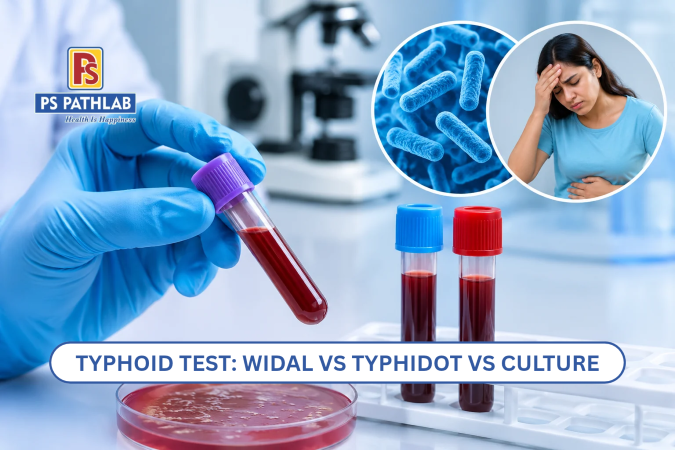
Typhoid Test (Widal vs Typhidot vs Culture): Which Test Is Best for Accurate Diagnosis?
Typhoid fever is a bacterial infection caused by Salmonella Typhi. It commonly spreads through contaminated food and water and can cause prolonged fever, weakness, headache, stomach pain, and digestive problems.
If you or a family member has a persistent fever, your doctor may recommend a typhoid blood test. But with different testing options available, one common question is, which is better—Widal, Typhidot, or blood culture?
In this blog, PS PathLab explains the differences between these three tests, their accuracy, limitations, and how doctors decide which test is appropriate for diagnosing typhoid fever.
What Is the Best Test for Typhoid Fever?
Blood culture is generally the preferred test for confirming acute typhoid fever because it can detect the bacteria responsible for the infection. Widal and Typhidot tests detect antibodies against Salmonella Typhi, but their results need careful interpretation.
The most suitable test depends on the duration of fever, previous antibiotic use, symptoms, and clinical assessment.
1. Widal Test—A Common Test for Typhoid
The Widal test is a serological blood test used to detect antibodies against Salmonella Typhi and Salmonella Paratyphi.
It measures two main antibody reactions:
- TO (O Antigen): Detects antibodies against the somatic antigen.
- TH (H Antigen): Detects antibodies against the flagellar antigen.
Advantages of the Widal Test
- Widely available in diagnostic laboratories.
- Relatively affordable.
- Simple blood sample collection.
- Can provide supportive information when interpreted correctly.
Limitations of the Widal Test
- May produce false-positive results.
- Previous typhoid infection or vaccination can affect results.
- Background antibody levels vary by geographical area.
- A single positive result cannot reliably confirm active typhoid.
Important: Widal test results should always be interpreted alongside symptoms, clinical history, and local laboratory reference ranges.
2. Typhidot Test—Antibody-Based Typhoid Detection
Typhidot is another blood test used to detect antibodies against Salmonella Typhi.
It commonly identifies:
- IgM antibodies: May indicate a recent immune response.
- IgG antibodies: May indicate previous exposure or a later immune response.
Advantages of Typhidot Test
- Can help provide supportive evidence of typhoid infection.
- Detects different antibody types.
- May be useful as part of the overall clinical assessment.
Limitations of Typhidot Test
- Cannot reliably distinguish active infection from previous exposure in every case.
- False-positive and false-negative results are possible.
- Performance varies depending on the test kit and timing of testing.
Important: A positive Typhidot result does not independently establish an active typhoid infection.
3. Blood Culture Test—Preferred for Confirming Typhoid
Blood Culture is considered the preferred diagnostic investigation for confirming typhoid fever, particularly during the early stage of illness.
It works by detecting and growing Salmonella Typhi bacteria from a blood sample in a specialized laboratory environment.
Advantages of Blood Culture
- Can directly identify the bacteria causing infection.
- Helps confirm Salmonella Typhi infection.
- Can provide antibiotic susceptibility information.
- Helps doctors select appropriate antibiotic treatment.
Limitations of Blood Culture
- Results may take several days.
- Previous antibiotic use can reduce the chances of detecting bacteria.
- A negative result does not completely rule out typhoid.
- Proper sample collection and laboratory handling are essential.
Important: Whenever possible, blood culture should be collected before starting antibiotics, as advised by the treating doctor.
Widal vs Typhidot vs Blood Culture: Key Differences
Feature: Widal Test, Typhidot Test, Blood Culture
Test type | Antibody test | Antibody test | Bacterial culture
Detects | O and H antibodies | IgM and/or IgG antibodies | Salmonella bacteria
Confirms active infection | No, not alone | No, not alone | Can confirm
Previous exposure effect | Yes | Yes | No antibody interference
Antibiotic effect | No direct effect on antibodies | No direct effect on antibodies | Can reduce detection
Main use | Supportive evidence | Supportive evidence | Bacterial confirmation
Which Typhoid Test Should You Choose?
The choice of test depends on the patient's symptoms, duration of fever, and medical history.
Here is a general guide:
- Early suspected typhoid: Blood culture is generally preferred for bacterial confirmation.
- Persistent fever: The doctor may recommend blood culture and other investigations based on symptoms.
- Widal or Typhidot testing: These may provide supportive information but should not be used alone to confirm active infection.
- After taking antibiotics: Inform your doctor and laboratory because antibiotics may affect blood culture results.
Never start antibiotics or self-medicate based only on a Widal or Typhidot report.
Common Symptoms of Typhoid Fever
Some common symptoms include:
- Persistent or prolonged fever.
- Headache and body pain.
- Weakness and fatigue.
- Abdominal pain.
- Loss of appetite.
- Diarrhoea or constipation.
- Nausea and digestive discomfort.
If you experience persistent fever or worsening symptoms, consult a qualified doctor for timely evaluation.
Severe abdominal pain, confusion, bleeding, or signs of dehydration require urgent medical attention.
Frequently Asked Questions (FAQs)
1. Which test is best for typhoid fever?
Blood culture is generally the preferred test for confirming typhoid because it can detect Salmonella Typhi bacteria directly.
2. Is the Widal test accurate for typhoid?
Widal can provide supportive information, but its accuracy is limited by previous exposure, vaccination, and background antibody levels. A single positive result cannot confirm active typhoid.
3. Is Typhidot better than Widal?
Both tests have limitations. Their diagnostic performance varies, and neither should independently confirm active typhoid infection.
4. Can CBC detect typhoid?
CBC may show changes in white blood cell count, hemoglobin, or platelets, but it cannot confirm typhoid fever.
5. How many days does a blood culture take?
Blood culture may require several days for bacterial growth and identification. The exact reporting time depends on the laboratory and the growth of bacteria.
6. Can antibiotics affect blood culture results?
Yes. Taking antibiotics before sample collection can reduce bacterial growth and may lead to a negative result.
7. Is fasting required for a typhoid blood test?
Generally, fasting is not required for Widal, Typhidot, or blood culture tests. Follow the laboratory's specific instructions.
8. Can Widal test be positive without active typhoid?
Yes. Previous infection, vaccination, and background antibodies can contribute to a positive Widal result even without an active infection.
Get Reliable Diagnostic Testing at PS PathLab, Delhi
Choosing the appropriate diagnostic test is an important step in understanding your health.
At PS PathLab, we aim to make diagnostic testing convenient through professional sample collection and reliable laboratory services.
Whether your doctor recommends a Widal test, Typhidot test, or blood culture, our team can help you with test-related information and booking assistance.
Why Choose PS PathLab?
- Professional blood sample collection.
- Convenient Free Home Sample Collection (subject to service availability).
- Multiple diagnostic testing services.
- Convenient appointment and report access.
- Patient-focused diagnostic support.
Visit PS PathLab.
Address: 198, Deepali Enclave, Pitampura, Basement, Delhi – 110034.
Website: https://www.pspathlab.com/
Call: +91 96674 92046
Book Your Diagnostic Test Today!
PS PathLab – Health Is Happiness.